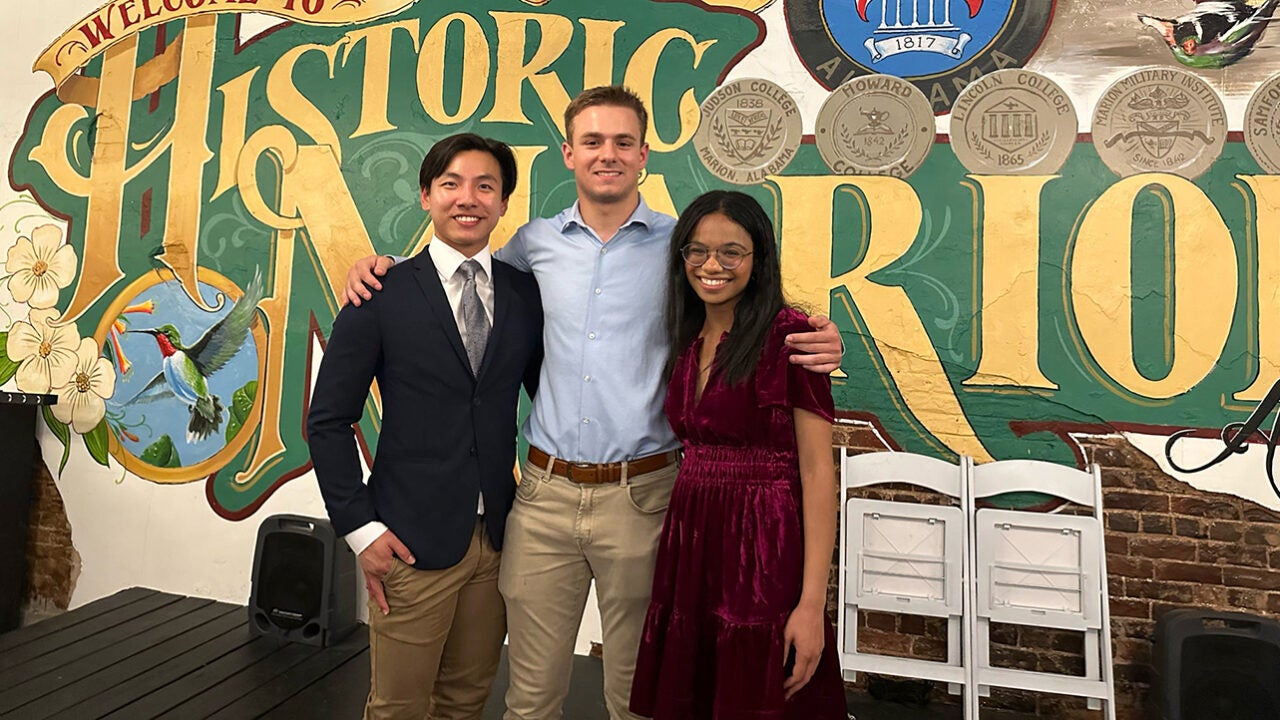
Since 2007, the mission of the Robert E. Witt Fellows Program within the Honors College has been to grow leaders through experiential opportunities. Open to incoming freshmen, the cohort of about 20-25 students is immersed in experiences that challenge how they see the world. It also helps them shape their viewpoints into tangible ways to serve their communities and become global citizens.
Why Witt Fellows?
Students in the Witt Fellows Program said they wanted to be a part of something that would help them grow intellectually.
“Coming from out of state, I wanted a community of intelligent and kind individuals who would push me to become a better person. Fellows seemed like a great fit for that,” said Luke Adams, a senior from Arkansas.
Zachary Warchol, a junior from Pennsylvania, agreed. “Joining the Witt Fellows program seemed like a great way to surround myself with other highly motivated students with a desire to make an impact on the community,” he said. “I also thought that the unique experiences that WFP provides, like the Black Belt Experience and the Cuba foreign excursion, would expose me to viewpoints and cultures that I would not have been able to learn about and experience otherwise.”
So, What is the Black Belt Experience?
Fellows take their passion for ethical community engagement to Marion, in the heart of Alabama’s Black Belt, for hands-on community development. Students get just as much from the experience as the people they’re serving.

The fellows spend a year studying WFP-specific courses about the American social support system, Alabama’s history and contemporary outlook, theories of ethical community development and project design and management.
Then they get to apply these lessons in May as they execute their action plans in Marion.
“My freshman year, I spent three weeks in Marion learning about the Black Belt region and working on a college preparedness program for local students,” said Madeleine Luther, a senior from Ohio.
Adams added, “Through Witt Fellows, I was able to learn the value of seeking to understand. This program showed me how to relate and empathize with others who are different than me, and why that’s important.”
And How About the Cuba Experience?

Since 2013, this international experience has taken Witt fellows to Cuba, where students learn about the challenges of limited resources in medicine and engineering, critical studies in organic farming and ecotourism. They also learn about the arts and the political environment.
This immersive excursion is another avenue of growth for the Witt fellows.
“As a junior, I traveled to Cuba with my cohort and learned so much about a nation that most Americans don’t get to see. My incredible experience with (Witt) Fellows has led me to pursue other opportunities across the globe, such as winning a Boren Scholarship in my junior year,” said Luther.
“As a Boren Scholar, I spent a semester abroad in Dakar, Senegal, the westernmost country on mainland Africa. Without the experiences given to me by fellows, I don’t think I would have even attempted to apply for the Boren.”
“The Black Belt Experience and our International Experience have fundamentally reshaped most of our students,” said David Bolus, assistant director of the Witt Fellows Program.
“They attract a lot of attention! But here’s the rub — we work in Marion, we do some deep seeking in Cuba. Marion and Cuba are not our laboratories. They are someone else’s home. Our cohorts are our laboratories.”

Witt Fellows is Shaping Global Thinkers
The Witt Fellows Program is focused on shared experiences. The students who are part of the cohort learn just as much about who they are as people as they do in becoming who they will be after graduation.
“They all come in with different ideas of what is interesting, what is just, what is worth caring deeply about. They might leave with some changes to those ideas, but they’re still leaving very different from one another,” said Bolus.
“To me, and from what I hear from alums, the deeper work is the most enduring work — and that’s in developing personhood. That’s wrestling with ambiguity and putting away binary thinking. That is pressing through discomfort to encounter with open minds new settings, viewpoints and situations. It’s taking a hard look at our own patterns to learn better why something is important to us and how to translate deep care into meaningful action. Most importantly, none of this happens alone.”
Adams agrees, “I also learned that to make deep relationships with others, I had to open myself up, which takes humility. C.S. Lewis said, ‘Humility is not thinking less of yourself; it’s thinking of yourself less.’ Fellows really stresses this concept. I have a long way to go, but I’m so grateful for how this program humbled me.”
“Being able to consistently have conversations and dialogue with open-minded, intelligent and thoughtful students on various topics has exposed me to new points of view and given me a more nuanced perspective on complex social issues,” added Warchol. “I expected this program to challenge me as a student and broaden my perspective. What surprised me about WFP was how close-knit the community is and how we all do our best to boost each other up.”
Bolus added that WFP is made stronger by the passion and commitment of the students themselves.
“At its core, community engagement is the work of relationship, and being a part of a fellows cohort is a four-year intensive in how to do the work of relationship. Your cohort is filled with people who think differently than you do, who take different kinds of actions, who care about different things, but because everyone has done their homework, everyone is right.
“How you decide to invest in your relationships with your cohort, and what exactly you do to build bridges and form bonds with people who are different than you, carries over into every workplace, every neighborhood, every community you will belong to the rest of your life.”
Learn more about the Robert E. Witt Fellows Program or follow the program Instagram.
Contact
Jennifer Brady, UA Strategic Communications, jennifer.brady@ua.edu