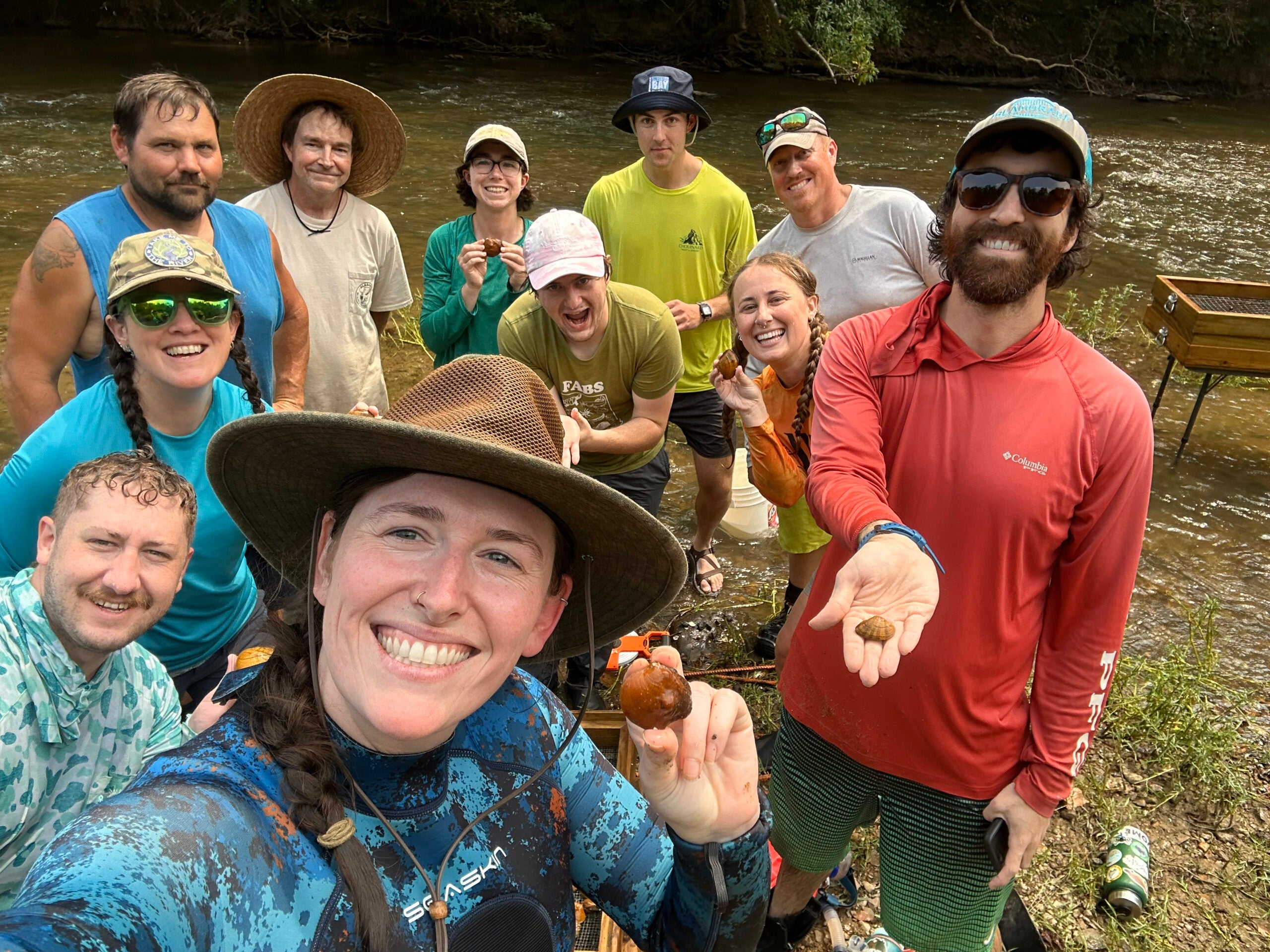
Dr. Carla Atkinson, an associate professor at The University of Alabama, describes her approach to mentoring students in ways that echo her research focus.
As a freshwater ecologist, Atkinson studies how the smallest parts of a freshwater system work together. Similarly, she makes a point of helping students understand how their work fits into the larger picture.
“Every project we do builds knowledge on the water quality of the system and the natural history of the organism. It also uncovers new questions,” she said.
The literal expression of that is one of her ongoing projects – a mussel trait database developed over two and a half years with her students. The database includes things like size, longevity and genetic information.
I saw all these filters on the bottom of the river. They were all mussels, just sitting there working away. It was absolutely incredible. I just thought, ‘They have to be doing something important.’
“We’re good at measuring the body size of mussels, but it illuminated to me how much we don’t know about the basic biology of these organisms,” Atkinson said. “For many, we don’t know the host fish species or how long they live.”
This compiled dataset provides a tool anyone in the country can use to further their research or identify research needs. From a teaching standpoint, Atkinson said engaging students in her lab with the database gave them a broader perspective on how their work contributes to the broader body of knowledge.
Nature’s Water Filters
Atkinson traces her interest in streams to a childhood in the Ozarks. Because she loved playing in a nearby stream, a relative gave her a snorkeling mask. She was instantly enthralled with the life she glimpsed under the surface.
Later, as a graduate student in ecology, Atkinson earned a summer research position at a field station in southern Georgia. She was snorkeling along a shoal and noticed something interesting.

“I saw all these filters on the bottom of the river. They were all mussels, just sitting there working away. It was absolutely incredible. I just thought, ‘They have to be doing something important,’” she said.
Those little bivalves are in fact an important part of nature’s water filter, removing nutrients, sediment and pollutants from the water.
Mussels matter because water quality matters: What kind of water do we want around us? Do we want to be able to go fishing or swimming? Do we want to drink water?
“One mussel filters about a liter of water per hour,” Atkinson said. “So imagine an entire riverbed covered with them and what they can do.”
Shelby Endowment for Distinguished Faculty
In 2025, Atkinson was recognized as an Endowed Shelby Distinguished Associate Professor, one of the inaugural cohort of Endowed Shelby Distinguished Faculty. The honor will enable her to continue and expand her research on Alabama’s stream ecosystems.
One current aim is to connect work from two previous grants that studied the population genetics of freshwater mussels and their fish host species. Juvenile mussels reach maturity only by attaching to the gills of a host fish, and they are particular about which species they hitch a ride with. Therefore, to conserve mussels — and their water-cleaning capabilities – scientists need a more complete understanding of that relationship.

Some of Atkinson’s other research focuses on aquatic insect biodiversity in Alabama’s non-perennial streams — streams that are dry part of the year — and insect distribution in Alaska and the Arctic, as part of a much larger collaborative effort.
“The Endowed Shelby Distinguished Associate Professorship will not only enhance my own research program, but in collaboration with colleagues, it will assist with broader scale research initiatives and freshwater biology and also conservation, both locally and regionally and globally,” she said.