Recently, several members of The University of Alabama community have been targeted by scams designed to look and sound official. These incidents serve as an important reminder that scammers often rely on urgency, fear and familiarity to deceive their targets.
In one scam, faculty and staff across campus have received text messages claiming to be from benefits@ua.edu. The message states that there has been a change in the employee’s compensation and includes a link to view the updated information. UA Human Resources does not communicate with employees about their compensation or benefits through text messages.
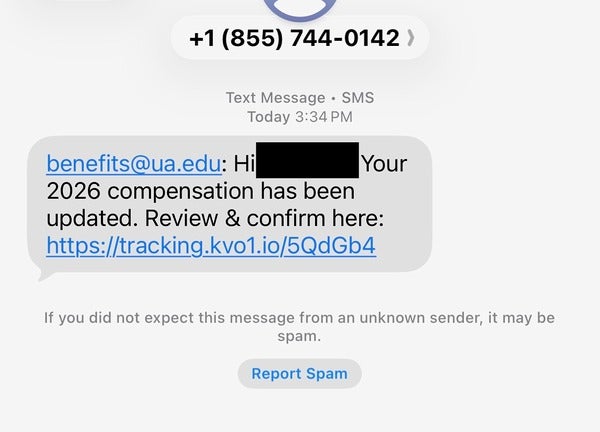
While the message may appear legitimate, these texts are phishing attempts meant to trick recipients into clicking malicious links or providing sensitive personal information. Phishing scams like this are especially common during tax season, when people may already be expecting messages about pay, benefits or financial changes.
Students have also been targeted by scam phone calls in which callers spoof the UAPD’s phone number (205‑348‑5454). In these calls, the scammer may pretend to be a UAPD officer and claim there is a warrant for the student’s arrest. The caller then pressures the student to make an immediate payment through a payment app such as Cash App or Venmo, or directs them to log in to a website where they are asked to provide personal information.
These calls are scams. UAPD will never call to demand payment or ask you to log in to a website to provide personal information.
How to Recognize a Scam
If you see any of these signs, it’s probably a scam.
- Messages that create a sense of urgency or fear — such as, “You must act now,” or “There is a warrant for your arrest.”
- Unexpected requests for payments, passwords or personal information
- Links in unsolicited texts or emails
- Requests for payment through gift cards or payment apps
- Messages about a “missed delivery” or needing to update shipping information for a package you didn’t order
- Offers that are too good to be true, such as free gifts, prize winnings and random job opportunities
- Caller ID numbers that appear official but feel suspicious
How to Protect Yourself
Spam Text Messages
- Do not interact with potential scam text messages. Even replying “Stop” or “No” confirms your number is active, and can make you susceptible to further scams.
- Forward the text to 7726 (SPAM). Most major carriers like Verizon, T-Mobile, and AT&T use this service to identify and block spam.
- Don’t click links in text messages unless you know for certain who sent the message.
- If a message claims to be from a University office, company, bank or law enforcement agency, contact them directly via their official website or phone number, not the one in the text.
- Report phishing emails or texts to security@ua.edu.
Scam Phone Calls
- If you don’t recognize the number, let it go to voicemail. If it’s important, the caller will leave a message.
- If you answer, hang up immediately. Don’t press any buttons or respond to any voice prompts as this confirms your number is active.
- Don’t send money just because a stranger calls and says you owe a fine.
- Don’t share personal information like your birthday, social security number, CWID or driver’s license number with someone you don’t know.
- Report scam calls to the Federal Trade Commission.
If you sent money after a scam call, or received a call from someone falsely claiming to be with UAPD, report it to the University of Alabama Police Department at 205-348‑5454.
Staying informed and cautious helps protect not only you, but the entire UA community. When in doubt, pause, verify, and report.
Safety Reminder: UA Alert System Test
Weather permitting, the University will test its emergency notification systems, including UA Alerts, the public address system and digital signage Wednesday, April 1, at 11:55 a.m.