
The IceCube Neutrino Observatory has successfully deployed the first expansion of its capability in 15 years. The IceCube upgrade added 600 new sensors to the existing array buried in a cubic kilometer of polar ice at NSF’s Amundsen-Scott South Pole Station in Antarctica. Among the 450 scientists worldwide who collaborate on the facility is a UA professor who helps translate raw data from the sensors to a form scientists can use.

Group photo of the IceCube Upgrade team with the drill tower, hose reel, and IceCube Lab in the background.
Dr. Dawn Williams, UA professor of physics and astronomy, is one of the project leads for calibration and characterization.
“In plain language, this role oversees all aspects of turning raw signals from the detector into actionable scientific information,” Williams said.
Her group is responsible for understanding how much light reaches each sensor, when that light arrives, and how to reconstruct the direction and energy of incoming neutrinos based on those signals. Their work also contributes to the effort to better understand the optical properties of the ice surrounding the sensors.
Messages from the Universe
IceCube uses more than 5,000 light sensors to capture the faint light emitted by secondary charged particles produced by neutrino interactions in the ice. The pristine quality of the Antarctic ice makes it an ideal medium for detecting this light. Scientists with the IceCube Collaboration then take these light patterns to reconstruct the energy and direction of the neutrino in order to determine its origin.
The upgrade will allow more precise measurements of properties like neutrino oscillations, a phenomenon where atmospheric neutrinos can morph into different types or “flavors” — electron, muon and tau.
IceCube has already been instrumental in advancing our understanding of the particles themselves as well as the distant (and relatively near) corners of the universe where they originate. With these improvements, IceCube will be the premier neutrino experiment for long-baseline oscillation measurements using atmospheric neutrinos.
Into the Icy Depths
Getting the new sensors into the ice has been a seven-year effort, including delays during and post-COVID. The final drilling and installation were completed in 2026 using a hot water drill system made in the US and shipped to the South Pole. An international team of engineers worked around the clock to drill the six 1.5-mile holes, with each hole taking about three days to complete.
As soon as each hole was drilled, the installation team deployed the instrument-laden cables into the water, which then froze back around the sensors.
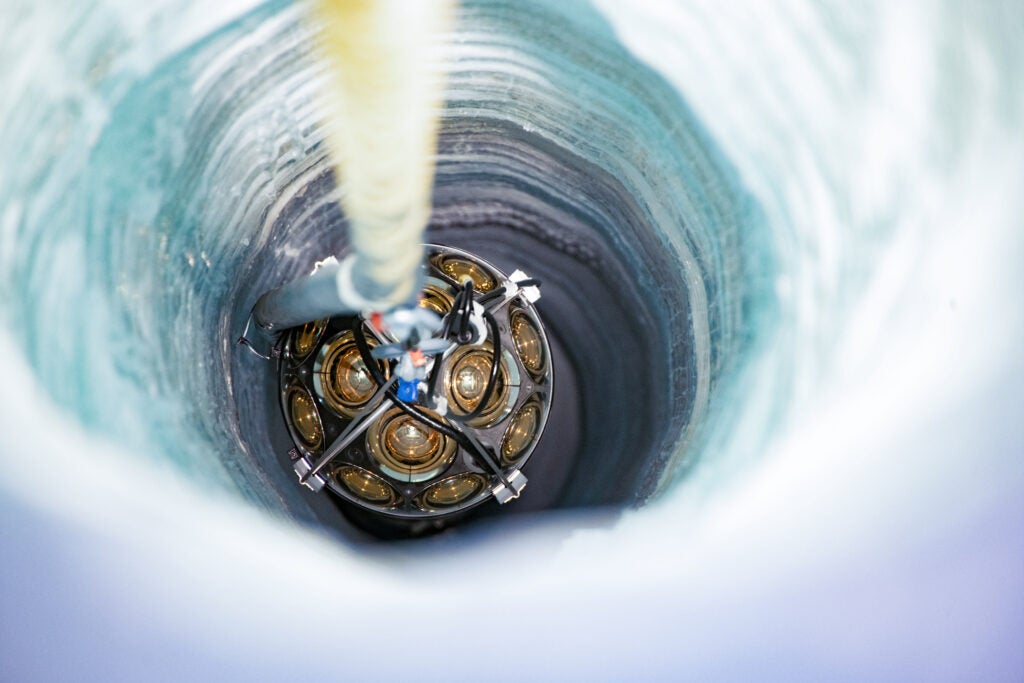
An mDOM sensor is lowered into a borehole.
Understanding the ice is central to IceCube science. As Williams explained, the observatory’s sensors are separated by tens to hundreds of meters, meaning every signal travels long distances through glacial ice that can scatter or absorb light. Studying the optical properties of the ice will improve the accuracy of neutrino reconstructions and enhance analysis of both new and historical data collected over the past 15 years.
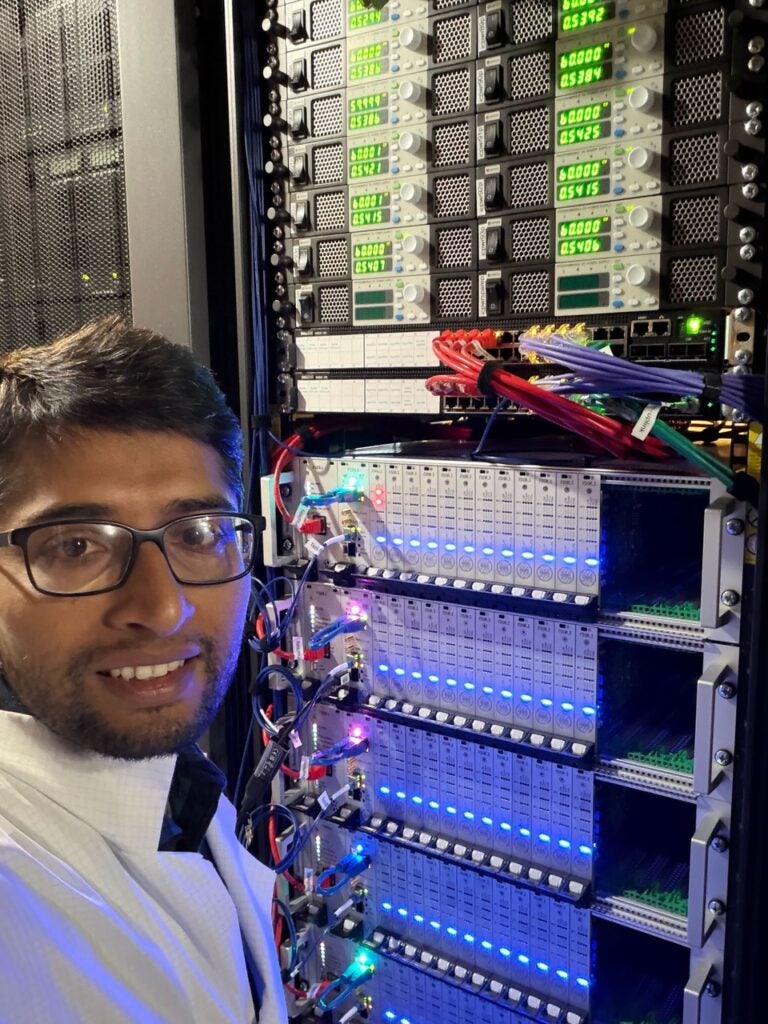
Dr. Ek Narayan Paudel, a postdoctoral researcher in Williams’ lab, helped with the drilling and installation and then led the daily operation of the upgrade modules as the water refroze. Each day, he ran the devices and then prepared the data to be transferred through satellite for analysis.
“Camera-equipped devices captured the freezing process of the upgrade holes, providing valuable insight into the ice surrounding the detectors. This information will ultimately improve the precision of neutrino measurements with the IceCube,” he said. “The opportunity to do science with an outstanding team in a special location like the South Pole was a deeply rewarding experience for me.”
Foundation for IceCube Gen2
Williams emphasized that the upgrade lays critical groundwork for IceCubeGen2, a proposed larger observatory. Her team is testing new calibration methods and ice modeling techniques that will be essential for designing and operating the planned next generation detector.
“I’ve been working on Ice Cube since I was a postdoc in in 2004,” Williams said. She has been involved with the facility since its construction in 2004. “So this is my life’s work.” She also served as a co-PI on the proposal for the IceCube Upgrade in 2016. Seeing the successful deployment of the new sensors after delays caused by the COVID-19 pandemic has been meaningful, marking a major milestone in a project to which she has been deeply committed for years.